
Bolton Castle was built by Sir Richard le Scrope, Lord Chancellor of England to Richard II. The licence to crennelate was granted and building commenced in 1379 and was completed in 1399. The family had raised to prominence a generation before under Sir Henry Le Scrope who was Chief Justice of The Kings Bench, Chief Justice of The Common Pleas and father of Sir Richard. Having said this, a member of the family called Richard FitzScrob – Scrob, being the earliest Norman spelling of the name Scrope – had built Richard’s Castle in Herefordshire in 1050, so the family must have borne some political power well before this time.
Between 1371 and 1375 he served as Lord Treasurer and was made Lord Chancellor in 1378, which post he held until 1380, but he then served again from 1381 to 1382. The following explanation was given for his having The Great Seal taken from him; “After the death of Edmund Mortimer, Earl of March, and of some other tenants in captive, numerous applications were made to The King for their lands, which fell to The Crown in consequence of the minority of their heirs. His Majesty, regardless of his own pecuniary necessities, having commanded The Chancellor to comply with those requests, Scrope ventured to remonstrate and urged the propriety of keeping the lands in The King’s own hands for the supply of exigencies. Incensed at this behaviour, Richard sent messenger after messenger to Scrope, desiring him forthwith to return The Great Seal, but he “(refused) to deliver it up to any person other than The King himself.”
The licence to crenellate Bolton Castle was granted in July 1379, although the contract with Johan Lewyn, mason, was made in September 1378. Leland (later – in the reign of Henry VIII) describes in his ‘Itinerary’ how Bolton was 18 years in building and cost 1000 Marks per annum and was completed in 1399. He also describes ‘An Astronomical Clock’ in the courtyard and the way “the smoke was conveyed from the hearth in the hall, through tunnils through the walls and no other louvers”. Sir Francis Knollys describes Bolton as having “The highest walls of any house he had seen”.
Sir Henry had served in the retinue of The Earl of Warwick in France and later with John of Gaunt. His first action was at The battle of Crecy, being Knighted at The Battle of Durham. He fought in every major campaign between 1346 and 1384, when he challenged Robert Grosvenor to his right to bear the Arms ‘Azure, a Bend d’Or’. In 1385, a General Proclamation was made throughout the host that all who were interested in the dispute should appear on 20th August at Newcastle on Tyne. The case took four years to be determined and judgement was given in Westminster Hall, in favour of Scrope. Many of the most interesting and powerful persons of the land gave evidence, including John of Gaunt and Owen Glendower.
He obtained the wardship of the three heiress daughters of Robert, Lord Tiptoft who was reputed to have salvaged King John’s treasure from ‘The Wash’. The three girls were betrothed to Scropes’ sons and are all left legacies in Scrope’s will where he refers to them as ‘my dearest daughters’.
There is considerable mystery as to the origins of the major Scrope wealth. Henry and Geoffrey Le Scrope reputedly founded the family fortune, however there is a problem with this. They undoubtedly acquired some land holdings, but on a minor scale. Henry also applied for a licence to embattle his manor house at Kirby Fleetham, but his declared remuneration from gifts and fees, never amounted to more than about £80 per annum (Brigette Vale). Richard Le Scrope spent a reputed 18000 Marks on building Bolton Castle between 1378 and 1399, he also bought the Kingdom of The Isle of Man for his son William for a further £10000. This represents about £90 million at today’s prices. He acquired some of his properties by lending money on the security of land. When people were unable to pay back these funds these lands and manors became forfeit to him.
Sir Roger, Sir Richard’s second son, becomes the 2nd Lord Scrope but outlives his father by only seven months. Succeeded by his 10 year old son, Richard.
Archbishop Richard Scrope, (son of Lord Scrope of Masham), executed for his part in Harry Hotspur’s plot and armed uprising against Henry IV. Archbishop Scrope was held in great veneration for sanctity; miracles were said to be wrought after his death and pilgrimages were made to the place of his burial.
Sir Richard is killed at the siege of Rouen and succeeded by his son Henry, 4th Lord Scrope who was only 2 years old at the time. Henry later supported Richard, Duke of York against Margaret of Anjou, wife of Henry VI.
John Scrope dies aged 63.
He leaves to his son and heir Henry ‘his parliament robes, and all his furniture at Bolton Castle’.
Bolton is fired by Henry VIll’s commissioners as a consequence of Sir John, 8th Baron Scrope’s support of the Pilgrimage of Grace.
The extent of the damage is not known but must have been considered sufficient punishment because Sir John was nevertheless summoned to Parliament and remained there until 1552 in the reign of Edward VI.
Mary, Queen of Scots, arrives at Bolton Castle in the care of Sir Henry, 9th Lord Scrope, and Sir Francis Knollys and is imprisoned for 6 months.
Having defended Bolton Castle for the King during the Civil War, John Scrope surrenders only after all the horses have been eaten and the garrison is starving. For this act of defiance, the Castle is slighted in 1647 although, by some good fortune, the South West Tower and West Curtain, complete with private apartments, remains habitable.
John Scrope dies in London either of the plague or is killed conducting espionage for the King and living under an assumed name. The estate passes to his sister Mary.
Parliament destroy the East Curtain and Garrison Quarters of the Castle making it militarily useless.
Mary marries her 2nd husband, Charles Paulett, 6th Marquess of Winchester, who becomes the 1st Duke of Bolton. Charles had been a member of the garrison stationed at the Castle during the six month parliamentarian siege. He returned to Bolton in 1653 after his release from the Tower of London to marry Mary.
Bolton Hall is completed and the family leave Bolton Castle.
The Castle’s North East Tower collapses.
The Dukes of Bolton again run out of male heirs. Bolton Castle and a great many of the 6th Duke’s other estates devolve on Jean Mary Powlett, natural daughter of Charles, the 5th Duke of Bolton. She is married to Thomas Orde, a politician, who adopts the Paulett name. He
becomes the 1st Lord Bolton in 1797.
Napoleonic Wars. Around this time the family changes the spelling of their name from Paulett to Powlett because ‘Powlett would appear less ‘French’.
William Orde-Powlett, becomes the 2nd Lord Bolton. The Castle remains in the hands of the Orde-Powlett family to this day.
Restoration work is carried out on Bolton Castle by William Thomas Orde-Powlett, 4th Lord Bolton.
Italian Prisoners of War help with restoration work on the North Curtain wall of Bolton Castle.
Work begins to preserve the Castle as found. Castle walls de-vegetated and re-pointed with the help of English Heritage. An archaeological survey is conducted and work beqins to re-instate the gardens an ongoing project for the twenty-first century.
On 9th June 2005 a mass and family gathering are held to commemorate the 600th Anniversary of Archbishop Scropes‘ execution with more than 80 members of the Scrope family and descendants attending.
What’s on
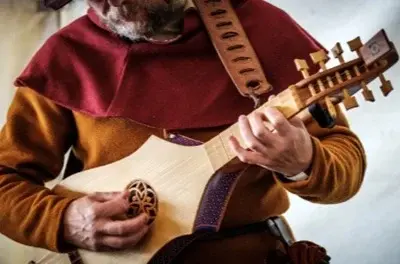
11–13 September
Medieval Music in the Dales
This is a private, ticket only event. The castle and gardens are closed to general visitors over these three days.…
10am – 5pm
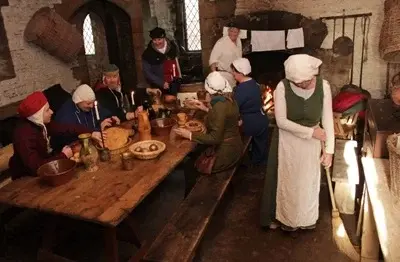
3–4 October
Lord Scropes Living History Weekend
It is Autumn 1461 and after a year of brutal warfare the country is more peaceful. The new Yorkist king,…
10am – 5pm
9 October
Evening Castle Tour
Fancy experiencing the castle after hours? A chance to feel the cool of the stone and soak up the history…
6-8pm